
A few weeks back, I went to a yoga class where my instructor said something that really stuck with me.
“This practice isn’t about finding the perfect angle or forcing yourself into a pose your body isn’t ready for,” she said. “It’s about listening to yourself — not just your body, but your mind and your soul, too. Sometimes, that voice tells you to push yourself. To do more. But other times, it tells you to do less. And listening to that voice is just as important as listening to the other.”
That was her invitation to us for that day — to do less. For me, it was particularly good timing, because I had come into class already having a rough chronic pain day, and my inner voice was telling me very loudly that it was not a good day to play around with standing poses or inversions. So I listened, and I did less. I spent a lot of time in Child’s Pose. I spent a lot of time in savasana, Corpse Pose. I rested.
I needed it.

Today is another do less day, complete with a migraine (boo). So for today’s Friday Five, I’ll be sharing pieces from around the internet that sparked my brain today with a short prompt to hopefully spark yours.
But if they don’t, that’s okay, too. You can just join me in doing less.
your friday five!
this week’s highlights on creating for good
”To Fandom, With Love” (Rebecca Epstein-Levi, originally published in Bitch Magazine, reprinted in The Flytrap)
Fandom allows us to collectively imagine and participate in better, more just, and more satisfying stories than the ones presented to us as fait accompli. It allows fans to, for instance, express collective outrage over the tendency to kill off pop culture’s queer, disabled, BIPOC, and sex-working characters, and then use what’s called “fix-it” fic to give those characters better storylines. Rabbinic text, too, participates in fix-it fic of a kind—as when, for example, it imagines a pious Jew mouthing off to a Roman soldier and not just living to tell the tale, but actually changing the soldier’s way of thinking. Such acts of imagination can powerfully shape real-world relationships of genuine care and support. The ability to draw a convincing portrait of a better world is, after all, a crucial skill for making a crisis feel just livable enough to keep on for a little bit longer.
Prompt: Write a love letter to a community that has given you comfort, safety, inspiration, or support over the past year. If at all possible, deliver it.
“Stop Saving Your Life For Later” (@fossilisedflowers on Instagram)
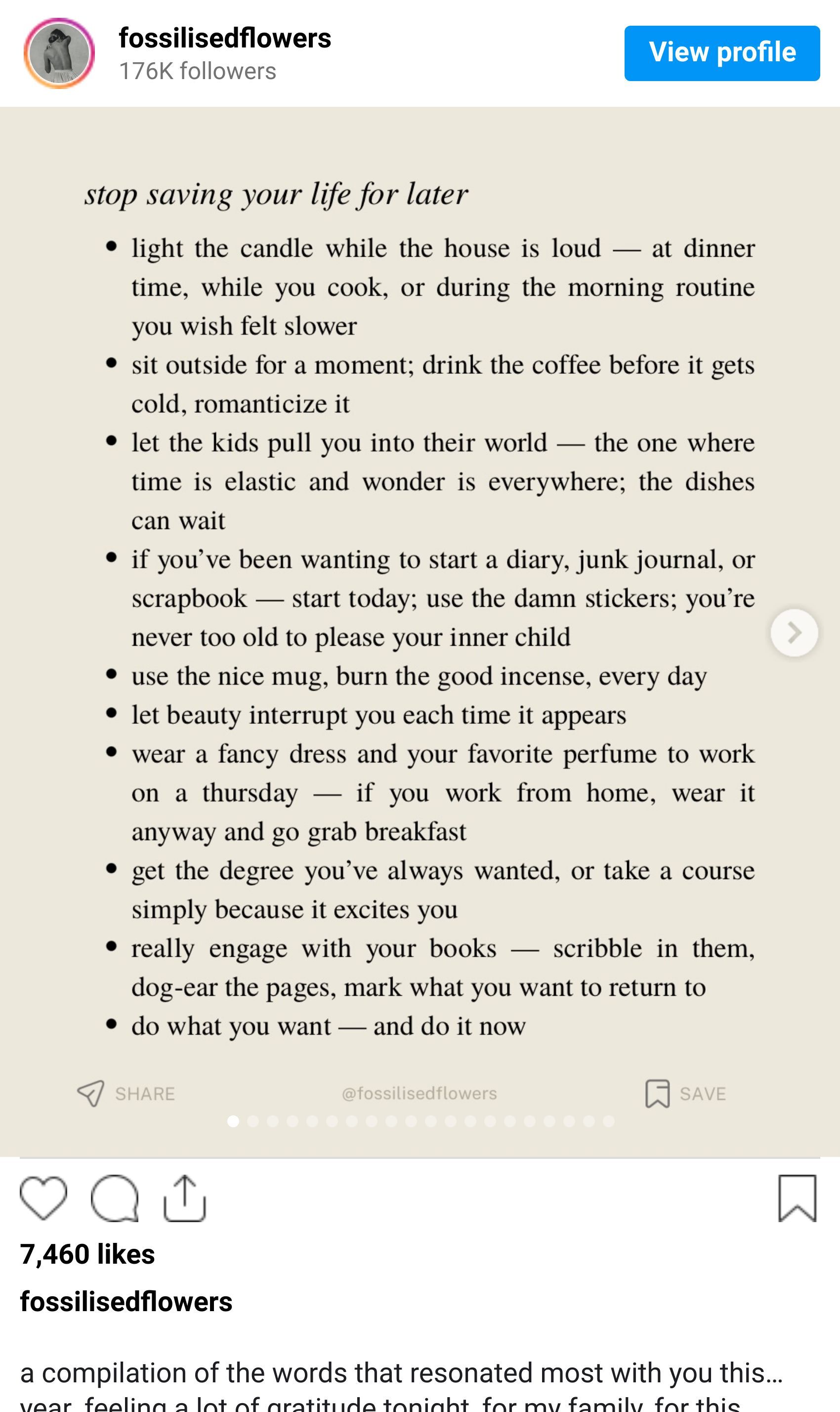
Prompt: Is there something you’ve been holding onto for a long time — a candle you’ve been waiting to burn, dishes you’ve been waiting to use, an outfit you’ve been waiting to wear — that you’ve been saving for just the right moment? Use it this week.
“A local librarian’s research helped secure a settlement for descendants of displaced Black Portlanders” (Ellen Clarke for Street Roots)
Last summer, the city of Portland paid millions to descendants of Black families forced from their homes by racist urban renewal projects. It was an effort decades in the making. And one of the driving forces was a local librarian.
Through her own research, the librarian discovered that her grandmother’s home was demolished by the city ahead of a planned expansion of Emanuel Hospital. The expansion never happened, and the city never paid a dime to the librarian’s grandmother.
A plaintiff in the lawsuit who goes by the name Byrd, the librarian later transmuted the traumatic events she helped document during a decade of research into what she calls “wearable history.” Byrd chose jackets made of denim, which she calls a universal fabric, as her canvas. She embellished the jackets with materials that reflect the story of gentrification, including colorful textiles, chains and signs printed on fabric.
Byrd does not see herself as an artist, and hardly even takes credit for making the jackets. Instead, she says, it was a spiritual journey to craft the jackets while immersing herself in the history of displacement.
“They created me,” Byrd told Street Roots. “I didn’t sit down and plan to study the history for 10 years. It came to me. It is all so spiritual. My spirit protected me by giving me a way to communicate that is nonverbal. They are words unspoken.”
Prompt: Have you ever thought that “someday” you’ll do something with your creative work that will make a difference to someone in a meaningful way? Write down three ways you can make that “someday” happen within the next three months.
”My Own Inner Elba” (Tal Levin for his newsletter, The Sword and the Sandwich)
Things I scorned for so long—because the world hates women, and things women love are not respectable—have been so good for me. They gave me a place to land, these stories about love. And maybe I’m tired, beyond tired, so tired I broke apart, of caring about being respectable and smart and reputable as a public intellectual; maybe all that drained the joy from my life a long time ago. And the world is too bad for that; the world is too bad to admit that badness inside. Guilt and pleasure should only go together when your pleasure hurts others, which reading romance novels doesn’t. It never hurt anyone to read a story about love.
Prompt: What is something that brings you joy that you’ve labeled as a guilty pleasure — something to hide, to only talk about with a disclaimer, to sheepishly admit you enjoy rather than proudly sharing it? Make an effort this week to talk about it openly with at least one person. (The internet counts!)
“Hope is…” (A collaborative Tumblr post)


Prompt: What is hope, to you?
Whatever it is: Create about it.
See you next week!
💜Shelly
